

The Bottom Line
Pricing is the most important decision in your business. Get it wrong, and you’ll work twice as hard for half the money. Get it right, and everything else becomes easier.One Entry Point
Discounted onboarding session for every new athlete60-80% off normal rate
Commitment Required
No one-off sessions—monthly minimumPredictable revenue
Frequency-Based
2x/month, 1x/week, 2x/week, or unlimitedSimple choices
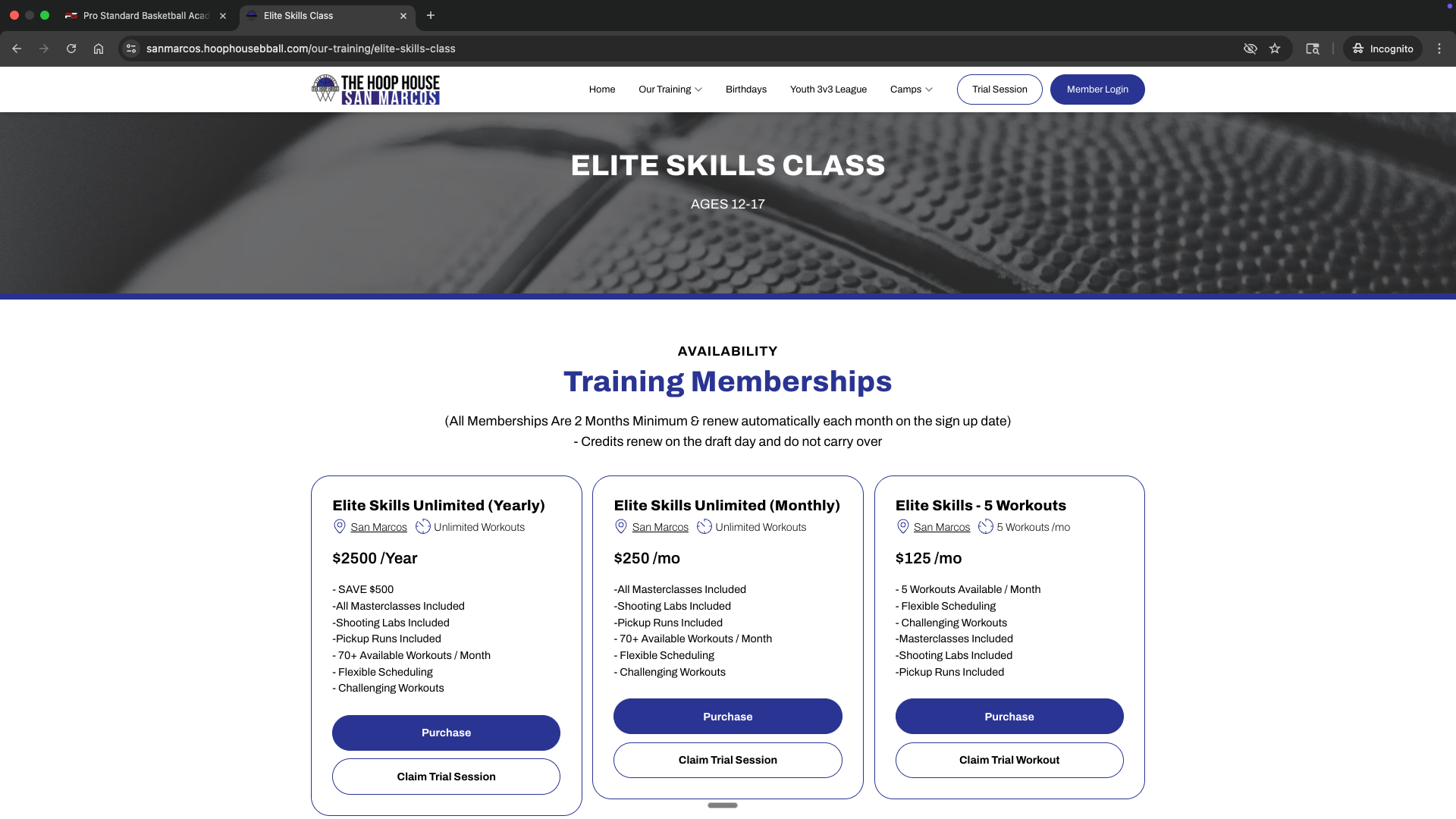
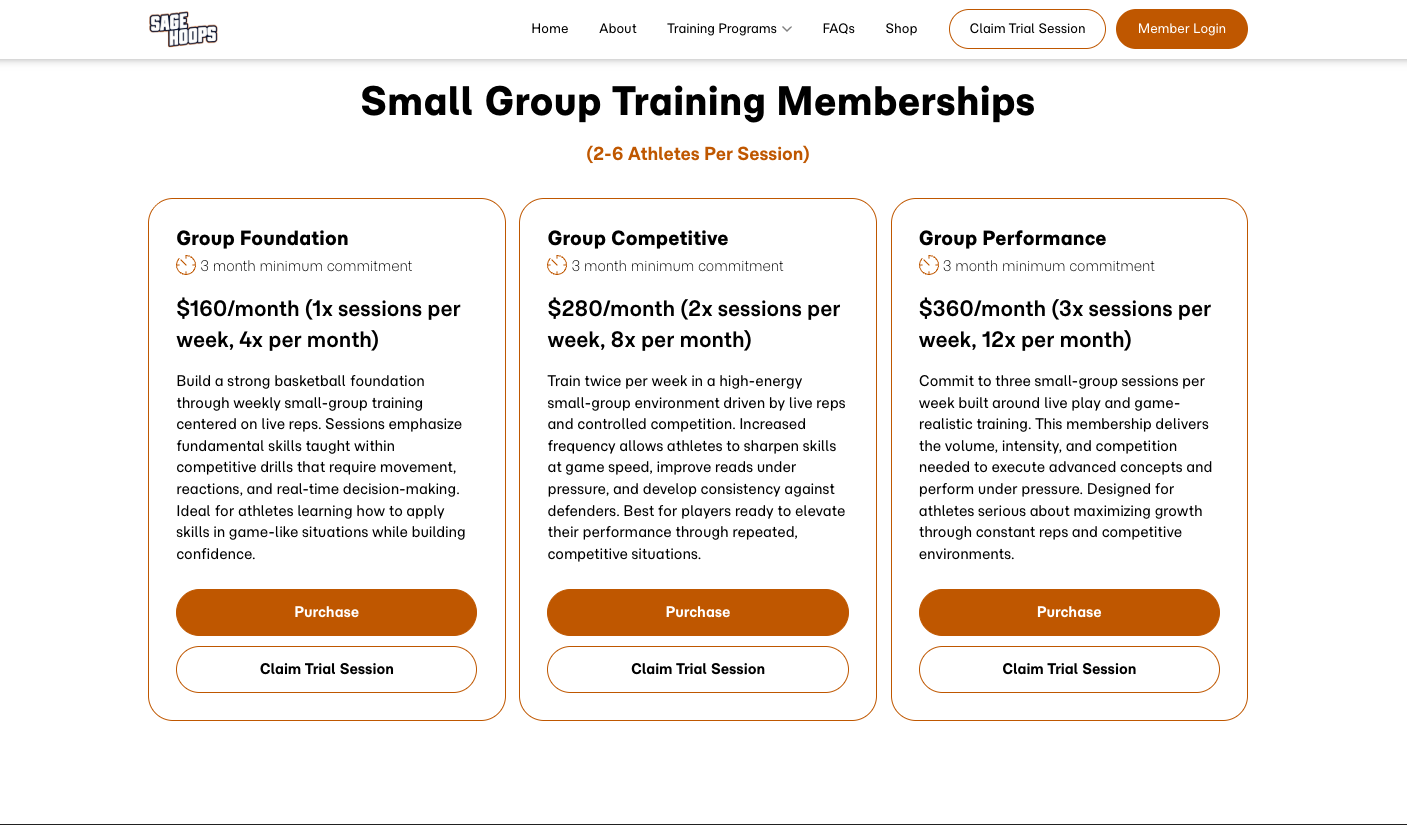
A well-structured pricing page: clear tiers, commitment-based packages, and a trial session entry point.
Not sure if your pricing is right? Pricing comes up in almost every onboarding call. Bring your packages to Office Hours and we’ll compare them to what similar facilities in the CoachIQ community charge.
Start with an Onboarding Session
Before you think about your actual pricing, nail your onboarding session. This is the entry point for every new athlete—the one thing you market to people who don’t know you yet.What is an onboarding session?
An onboarding session is a discounted first session (typically 60-80% off your normal rate) designed to get new families in the door. It’s a no-brainer offer that removes the risk for parents who are on the fence.Why it works
Parents don’t know you. They don’t trust you yet. Asking them to commit to a training package before they’ve met you is a big ask. The onboarding session solves this by: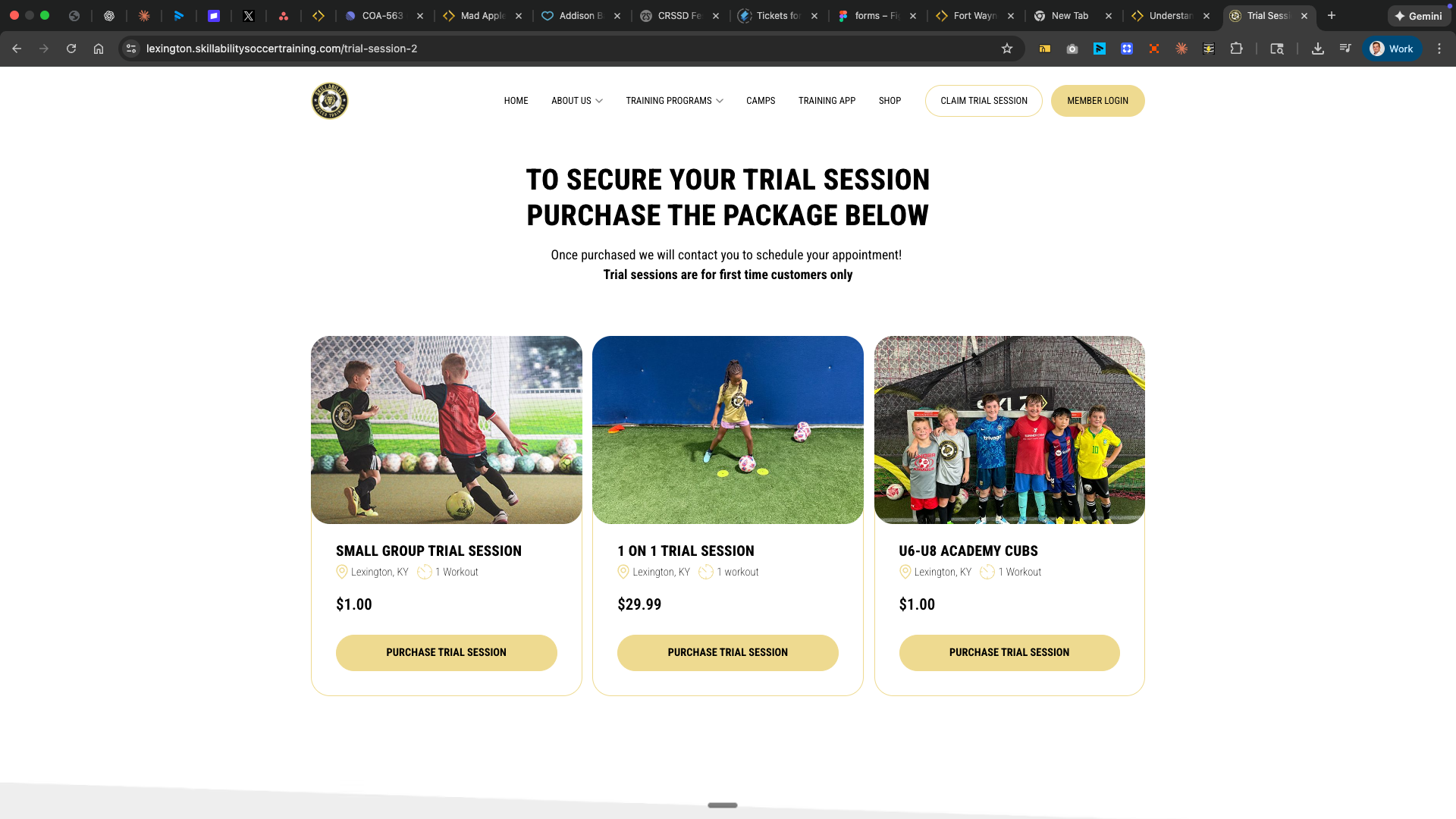
Charge something. Brandon Evans at Pro Standard Basketball Academy in Fort Wayne ran a free trial for years and watched no-show rates stay high no matter how many reminder calls and texts went out. He moved the trial to $10 with a card on file, and the no-shows stopped. His explanation: “They already have skin in the game. They’re invested. Even $10. Like, you put your card in and it’s on file now. You are invested.” The trial can be nearly free. It should never be nothing.
Three entry points from the CoachIQ community
Three entry points from the CoachIQ community
- Coach Stefano Soccer (Freehold and Middletown, NJ) sold a $1 one-week all-access pass behind a Facebook ad. Every new family got a full week of small-group sessions, speed classes, and strength work for a dollar, then hit the monthly membership wall.
- Elite Baseball and Softball Training (Grand Rapids, MI) charges $250 for a one-on-one assessment with HitTrax and TrackMan, and the athlete leaves with a written report and a training plan. Athletes who join a team get the assessment credited back inside their package. The entry point costs more than a trial because the report is worth more than a trial.
- Schmidt Performance (Northern Colorado) does the opposite: the first in-person session is free, and Jeff filters hard on fit before and after it. “I’ve turned clients down before that weren’t good fits.”
What happens during the session
The onboarding session serves two purposes: data collection and trust building. You’re not just running drills. You’re listening:1
Understand Their Goals
What does the parent want for their athlete? College recruitment? Making the team? Building confidence?
2
Assess the Athlete
What are their strengths? Weaknesses? Current skill level? How do they respond to coaching?
3
Learn Their Schedule
What sports do they play? When are they available? What’s their commitment capacity?
4
Match to a Package
By the end, you know exactly which package fits—and the sale becomes natural.
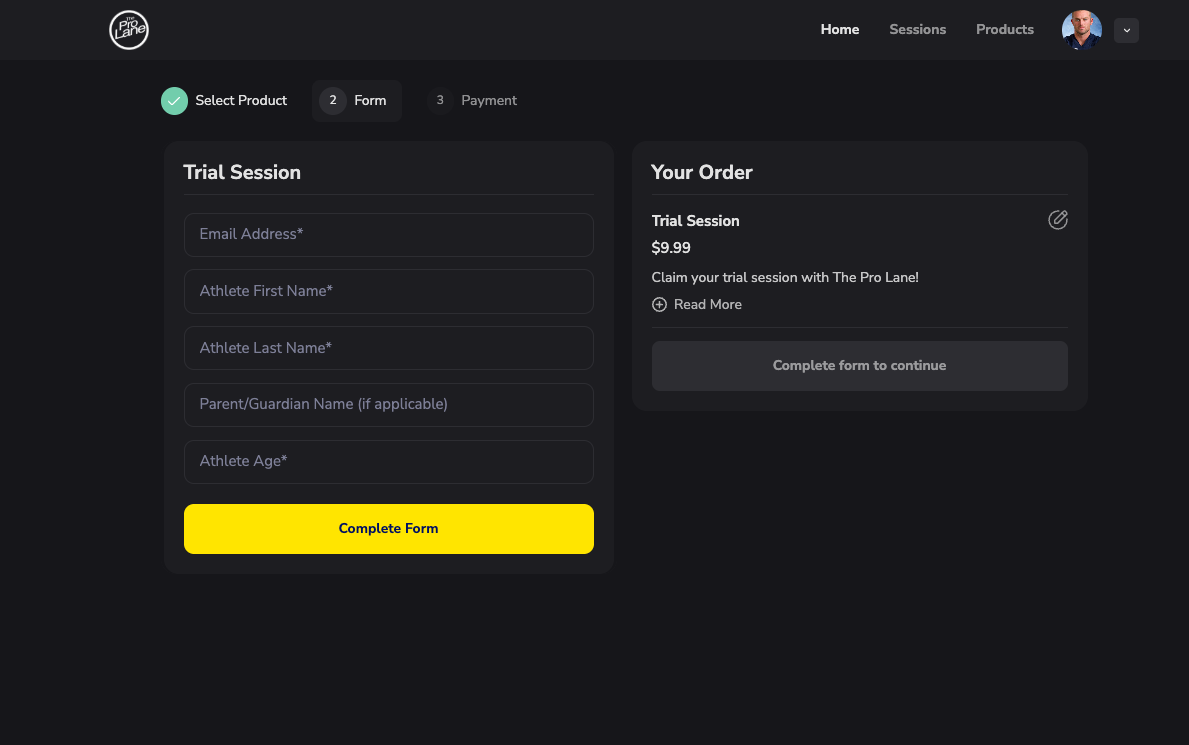
The checkout form collects key data: athlete name, age, parent contact, and more.
CoachIQ tip: Our Product Builder makes it easy to create a trial session product with custom intake forms. Collect athlete age, position, goals, and parent contact—all before they walk in the door.
Commitment-Based Pricing Only
Here’s the most important principle: no one-off sessions. Ever. Your pricing must involve some form of commitment. This is non-negotiable if you want to build a sustainable business and actually help athletes improve.Why this matters for athlete development: You can’t help someone get better if they show up randomly. Consistency is everything in sports training. Commitment-based pricing aligns your business model with what actually works.
Why commitment matters
Commitment structures that work
The most common commitment is monthly, but many facilities have great success with 3-month or 6-month commitments. The minimum should always be one month.- Monthly
- 3-Month
- 6-Month / Annual
Best for: New facilities, testing pricing, flexible markets
- Lowest barrier to entry
- Easier to sell after onboarding
- Higher churn risk
- Most common starting point
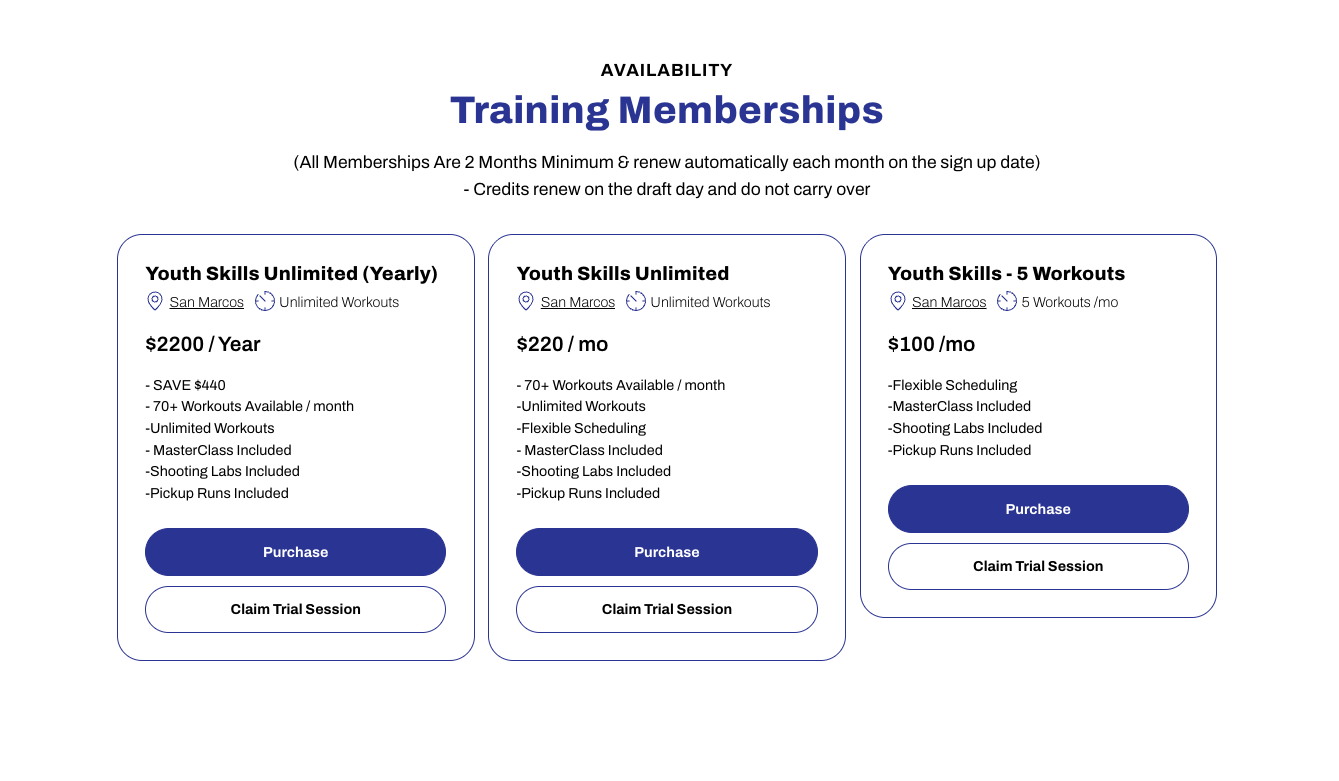
Real-world example: how four facilities structure commitment
Real-world example: how four facilities structure commitment
Jeff Schmidt’s reason for moving off prepaid session banks and onto subscriptions is the whole argument in one sentence: “I wanted to get rid of the upfront pricing. I think it allows parents to think that they have so many sessions and they can use them whenever they want.”
CoachIQ makes this easy: Subscription management auto-charges cards on file, and the credit system automatically tracks each athlete’s sessions, cancellations, and rescheduling—all visible in their app.

CoachIQ subscription management shows active subscriptions, monthly revenue, and status at a glance.
Keep It Simple: Frequency-Based Packages
Parents are not experts. They don’t understand—or care about—the nuanced difference between video analysis, skill work, strength training, and mental preparation. They just want their athlete to get better. Your job is to make that happen. Their job is to choose how often to show up.The packages that work
Most successful facilities offer exactly four options:
That’s it. The parent picks a frequency, commits monthly (or longer), and you handle the rest.
How CoachIQ handles this: Build each package as a subscription product that grants credits every billing cycle. 1x/week = 4 credits/month. 2x/week = 8 credits/month. Unlimited = ∞ credits. Athletes see their balance in the app and book sessions until credits run out. No spreadsheets, no manual tracking.Learn more: Recurring Credit Memberships
The pitch
After an onboarding session, the conversation sounds like this:- Standard Close
- Busy Family
- Serious Athlete
“I can definitely help your son reach his goals. Here’s how we work—can you come in once a week or twice a week?”Simple binary choice. Most parents pick one.
Avoid One-on-One Sessions
This is a trap that destroys coaching businesses. Avoid it.Why one-on-one doesn’t scale
Small groups are better for everyone
A small group of 4-10 athletes at similar skill levels is how you maximize development. Athletes feed off each other. You can run competitive drills and game-like scenarios. The energy is higher. And for your business? You’re making 4-10x more per hour than one-on-one would generate. Lee Taft, who built speed-training facilities to 150 athletes within a year and has consulted for nine NBA teams, rejected one-on-one from the start: “My hourly rate was tremendous, but each person wasn’t paying that much. As where if I ever did privates, I had to charge a lot and people couldn’t do it for very long.” Brandon Evans at Pro Standard went further and removed individual sessions from the menu entirely: “I don’t believe in individual workouts as a concept for getting people better.” He calls it the biggest operational improvement he’s made.If a parent insists on one-on-one training, that’s a red flag. Protect your time and your business model. The right response: “We’ve found athletes develop faster in our small group environment. That’s how we structure all our training.”
Pricing to Your Market
There’s no universal “right” price. Pricing depends on your location, your market, and the type of business you want to run.How to find your price
1
Research Your Market
What are other facilities and coaches charging in your area? Call them. Check their websites. Get a baseline.
2
Decide Your Positioning
Are you premium (higher price, fewer athletes, more personalized) or volume-based (more accessible, higher capacity)?
3
Factor in Your Costs
Rent, equipment, staff, insurance, and your own time. Make sure your pricing covers costs with healthy margins.
4
Test and Adjust
Start slightly higher than you think. It’s easier to offer discounts than to raise prices on existing clients.
Typical ranges by market
Need help pricing for your specific market? CoachIQ’s onboarding team reviews your pricing against comparable facilities in your area. We’ve helped hundreds of coaches find the sweet spot between competitive pricing and healthy margins. Book a call with our team to review your pricing strategy.
Add-Ons Follow the Same Rules
Once you’ve nailed your core offer, you can add supplementary services like video analysis, mental coaching, or specialized training. But the same principles apply.How to structure add-ons
Subscription-Based
Not one-off purchases. Monthly add-on to their existing package.
Optional
They enhance your core offer, not replace it. Core training comes first.
Simple
One or two add-ons maximum. Don’t recreate the complexity problem.
Example: A softball facility offers video analysis as an add-on. Athletes subscribe to the core training (1x/week at 75/month for one video analysis session per month.Total: $275/month for training + video analysis. Clean, simple, valuable.
Camps, Clinics, and Team Training
Most facilities run more than weekly training. Camps and clinics are the second most common revenue line among CoachIQ facilities, and team training fills the floor on nights the memberships don’t. They follow different rules than your core packages.
Two rules carry over from your core pricing:
- Members get first access, not a discount. Open camp registration to current families a week early. That rewards commitment without undercutting your monthly price.
- Every camp is an onboarding session at scale. Collect parent contact and athlete details at registration, then follow up with the frequency pitch. The camp roster is your best lead list of the year.
Real-world examples: camps, clinics, and team packages
Real-world examples: camps, clinics, and team packages
CG Hoops in Chesterfield, Missouri runs the camp side the way the guide describes. Most of the top local players train there, the camps sell out at capacity every time, and the business posted its three best revenue months ever this year. The camps feed the memberships, not the other way around.Elite Baseball and Softball Training sells 90-minute drop-in clinics at $100 as an upsell to members and an on-ramp for new families, and prices its travel-team packages by age group: $750 for 8U-9U up to $1,450 for the top 15U-18U tier, each bundling a facility membership, a set number of team practices, the one-on-one assessment, and pro-shop discounts. Families pay in full or in four monthly payments, and the fee is non-refundable except for a verified season-ending injury. On tryout night, Elite sends a link to collect a commitment fee before families can shop other programs.If you run teams out of your building, that last move is the one to copy.
How CoachIQ handles this: Camps and clinics are one-time products attached to a scheduler with a capacity limit. Attach your waiver so registration collects the signature, and use the intake form to capture the details you’ll need for the follow-up. See Product Types.
Raising Prices
If you’ve been undercharging, raising prices is uncomfortable but necessary.The safest approach
Grandfather existing clients at their current rate and raise prices only for new clients. This protects your relationships with loyal families—who are likely your best source of referrals. In CoachIQ, existing subscribers keep their price when you change a product’s price; see Grandfathering Client Pricing.Timing matters
If your facility has a natural break—a holiday, off-season, or month you’re closed—that’s the ideal time to implement new pricing. It feels less abrupt and gives everyone a clean reset.Not Every Client is a Good Client
As you grow, you’ll learn that some families aren’t worth the headache. Two owners who’ve earned the right to say no. Jeff Schmidt at Schmidt Performance: “I don’t want just anyone coming into the program. It’s not a revolving door. I want to make sure we’re getting the right kids and it’s the right fit on both sides, not just their side.” Elite Baseball and Softball Training puts it in the membership guide every family reads: “We are not a recreational program, and we are not for everyone.” The flip side is rewarding the families who are the right fit. Schmidt’s referral program gives a member 10% off for every family they bring in, for as long as that family stays. The discount leaves when the referral does.Quick Reference: Pricing Principles
The Onboarding Session
The Onboarding Session
- 60-80% off your normal rate
- The one thing you market to new leads
- Used for data collection and trust building
- Every new athlete enters through this door
Commitment Structure
Commitment Structure
- No one-off sessions—ever
- Minimum one month commitment
- 3-month and 6-month commitments work great
- Auto-billing through CoachIQ subscriptions
Package Options
Package Options
- 2x per month (tune-ups)
- 1x per week (standard)
- 2x per week (serious athletes)
- Unlimited (high-volume)
Group Training
Group Training
- Small groups of 4-10 athletes
- Similar skill levels together
- Better for development AND business
- Avoid one-on-one at all costs
Pricing Your Market
Pricing Your Market
- Research local competitors
- Decide: premium or volume?
- Typical range: $40-60/session
- Adjust for your specific area
Raising Prices
Raising Prices
- Grandfather existing clients
- Raise prices for new clients only
- Use natural breaks (holidays, off-season)
- Protect referral relationships
Ready to Set Up Your Pricing?
Everything in this guide maps to a part of CoachIQ:Pricing Page
Put your packages on your website with a trial-session button as the only call to action
Subscriptions
Cards on file, automatic billing, Past Due visibility
Credits
Each package grants credits; athletes book against them
Products
Build the trial session, the packages, and your camps
Want a second opinion on your numbers? Book an Office Hours call. We’ll look at your packages next to what comparable facilities in the CoachIQ community charge and tell you where you sit.
What’s Next?
Adding Clients
Get a new family into CoachIQ after their onboarding session
Getting Found Online (SEO)
Now that the offer is right, make sure parents can find it
Last reviewed: September 2026.